Solutions
FOR BUSINESSES
Asset Link
White-labelEmbed branded verification flows directly in your platform. Your look, our infrastructure.
Verify Portal
EasiestSend verification requests by email — like DocuSign for crypto. No integration needed.
API
DeveloperProgrammatic access to trigger verifications. Full control, no UI required.
Frontyr
24/7 BankingEnable 24/7 money movement with stablecoins and digital assets.
FOR HOLDERS
Prove
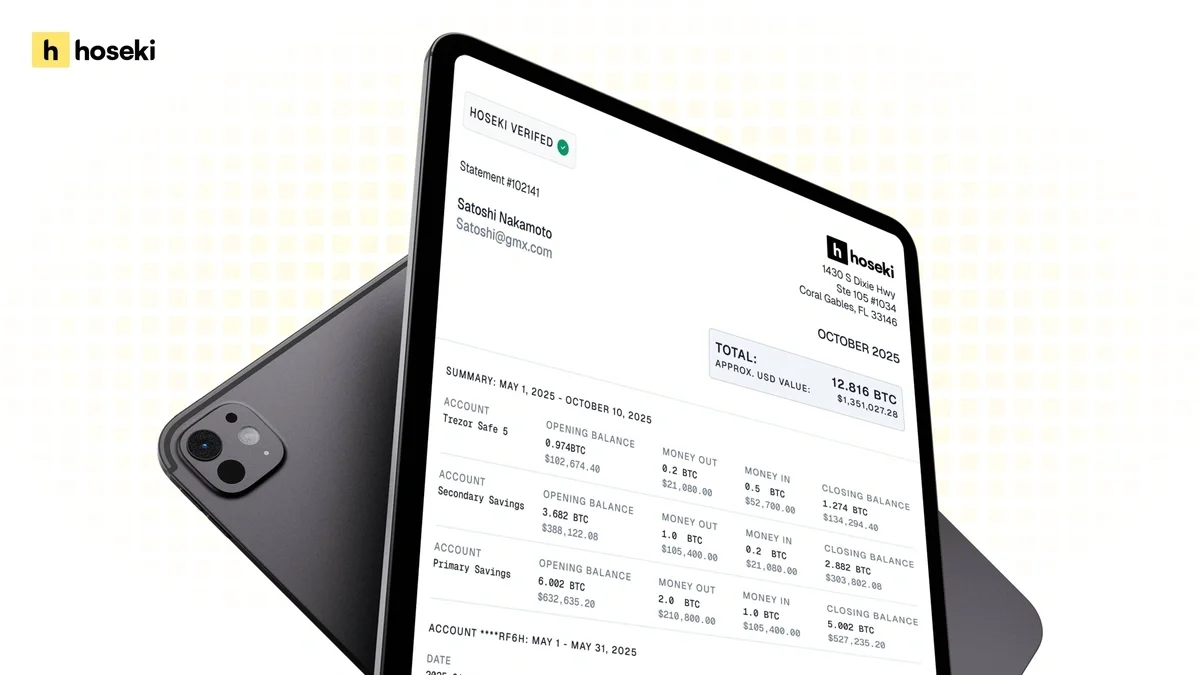
Generate cryptographically-verified statements for your Bitcoin and digital assets. Sign a message, get a verifiable proof. No private keys ever shared.
Get your statement
FOR BUSINESSES
Asset Link
White-labelEmbed branded verification flows directly in your platform. Your look, our infrastructure.
Verify Portal
EasiestSend verification requests by email — like DocuSign for crypto. No integration needed.
API
DeveloperProgrammatic access to trigger verifications. Full control, no UI required.
Frontyr
24/7 BankingEnable 24/7 money movement with stablecoins and digital assets.
How Banks Can Responsibly Adopt Digital Assets
Part 1: Bringing Digital Asset Wealth Into the Lending Process
For more than a century, banks have played a foundational role in how Americans save, borrow, and build financial lives. And despite the rise of large national institutions, local and regional banks remain essential pillars of their communities. A healthy financial system depends on many strong institutions, not a handful of centralized ones.
That’s why it's important for banks to stay connected to how their customers are building wealth today — especially younger generations whose financial behavior looks very different from their parents'.
Consumer confidence in the dollar’s ability to store long-term value has — understandably — deteriorated. As a result, many Americans, Gen Z and Millennials in particular, have turned to alternative assets they believe will better preserve their purchasing power over time. Some have leaned more heavily into equities like the S&P 500, others into gold which has made a notable comeback, but a rapidly growing share have adopted digitally native assets such as Bitcoin as a form of long-term savings.
Over the last decade, a quiet but undeniable shift has taken place in where people store their wealth, and it has major implications for the future of bank lending.
This shift isn’t about unreasonable speculation or get-rich-quick schemes.
It’s about savings — and how people feel they can best store their hard-earned purchasing power.
Are banks equipped with the tools they need to evolve into this new savings paradigm? Or will they be left behind as growing percentages of their customers save in assets they can’t see?
The shift in savings
Digital assets are no longer a fringe experiment. They’ve become a meaningful savings vehicle for a significant portion of the population.
Ownership is widespread:
- A 2025 consumer report estimates that 28% of American adults — roughly 65.7 million people — own cryptocurrency, up from 15% in 2021.
- A separate Gallup poll finds about 14% of U.S. adults currently hold crypto, depending on methodology.
- Globally, crypto ownership is estimated at over 560 million people, or about 6.8% of the world’s population.
Younger generations treat digital assets as core savings:
- Younger adults (18–34 years old) account for around 51% of global crypto holders.
- A CFA Institute study found that 55% of U.S. Gen Z investors hold cryptocurrency — making it their most common investment, ahead of stocks and mutual funds.
And importantly, for today’s main use cases, this isn't being used like spending money:
- The Federal Reserve's 2024 SHED report finds that 7% of U.S. adults held crypto as an investment, while just 2% used it to pay for something and 1% used it to send money to friends or family.
- A 2025 Kansas City Fed briefing finds that less than 2% of U.S. consumers use crypto for payments, a number that's declining year over year.
The signal is clear:
For millions, digital assets are functioning as savings and investment assets. Numbers this large cannot simply be attributed to speculation or dismissed as fringe behavior.
Yet when these customers apply for loans, mortgages, or credit lines, this portion of their wealth is completely invisible to traditional banks.
Why this matters for lending
While crypto-first lenders have explored collateralized digital asset loans, traditional banks face a more basic challenge:
Digital asset wealth is completely blocked out of the current lending process.
Today, banks routinely consider:
- Checking and savings balances
- Brokerage accounts
- Retirement accounts
- Equity portfolios
- Business assets
…as part of a customer’s financial picture.
But digital asset holdings — regardless of size — have not been included.
As of 2025, this has real downstream effects:
- Borrowers appear weaker on paper than they really are
- Loan applications get denied despite customers having meaningful savings
- Risk models underestimate borrower resilience
- Younger customers feel underserved and go elsewhere
- Banks lose cross-sell, deposit, and relationship opportunities
Even small amounts of invisible savings matter. If 20% of a bank’s customers hold digital assets — consistent with national averages — that could represent tens of millions of dollars in unrecognized net worth across a typical retail base.
Younger generations, in particular, are often digital-asset-heavy — leaving them institutionally invisible.
Why banks haven’t recognized this wealth to this point
For years, the consensus narrative inside traditional financial circles was simple:
“Crypto is a ponzi scheme that will eventually go to zero.”
That perception wasn’t irrational.
Banks are inherently risk-averse institutions. New asset classes must prove themselves over long periods of time, under stress, across cycles. And to be fair, many crypto projects were scams — which understandably reinforced caution.
But here’s what’s changed — and why it matters:
1. Bitcoin isn’t new anymore
Bitcoin has existed for 16 years. It has survived:
- Multiple boom/bust cycles
- Exchange failures
- Fork wars
- Regulatory crackdowns
- Media cycles
- Global macro shifts
And yet it remains a multi-trillion-dollar asset class.
At some point, durability — and its performance — becomes a data point.
2. For younger generations, it’s “the new savings technology”
Surveys consistently show that for Millennials and Gen Z:
- Bitcoin is viewed as a long-term store of value
- Crypto is their top-held investment
- They trust digital asset infrastructure more than large incumbents
This isn’t a speculative fad — it’s a generational shift in financial behavior.
3. The banking system never built a way to ingest this data
Even if banks wanted to recognize digital assets as part of a borrower’s net worth, they would run into immediate structural blockers.
Digital assets differ from traditional assets because there is no single place they must be custodied. Because they are digitally native, it is entirely normal for someone to hold:
- Some assets on an exchange
- Some in one or more self-custodial wallets
- Some in multi-signature setups
- Some pledged or locked elsewhere
As a result, understanding total ownership has unique challenges:
- No standardized or regulated way to prove ownership
- No bank-friendly equivalent of a brokerage statement
- No way to distinguish verified holdings from screenshots
- Fragmentation across exchanges, hardware wallets, and multi-signature solutions
In short:
Banks didn’t ignore digital assets because they didn’t care —
they ignored them because they assumed they would disappear,
and because there was no infrastructure to recognize them even if they didn’t.
But at this point, digital assets aren’t disappearing. And it’s reasonable that the next generation expects banks to acknowledge this savings technology.
Adoption starts with visibility
The path forward isn’t radical. Banks don’t need to rewrite risk models, take custody of crypto, or offer crypto-backed loans. They simply need to recognize digital asset holdings the same way they recognize brokerage or retirement accounts today — as part of a customer’s overall financial health.
Doing that responsibly requires:
- A standardized, verifiable way to prove ownership
- A consistent, bank-readable reporting format
- The ability to distinguish self-custody, exchange custody, and hybrid setups
- Clear internal policies for how these assets factor into underwriting
- Infrastructure that can normalize these holdings into existing banking systems
In short: banks don’t need to become “crypto banks.” They just need visibility into savings that already exist.
A New Chapter for Banking
Digital assets have become a meaningful part of how millions of Americans save — especially younger generations who represent the future customer base for every bank in the country.
Ignoring this wealth doesn’t make lending safer. It makes underwriting less accurate and banking less relevant.
And because we should want our financial system to remain as decentralized and diverse as possible, the more banks that understand and recognize this wealth, the better. A world where all liquidity and financial services get absorbed by a few large firms is not a healthy one.
Fortunately, there is a clear first step:
Start recognizing digital asset wealth for what it is: real savings.
Once that foundation is in place, everything else — better underwriting, better customer relationships, and smarter financial products — becomes possible.
If you’re a bank, credit union, or LOS provider exploring how digital assets can fit into your lending or customer evaluation workflows, Hoseki is building the infrastructure to support you.
Reach out here and let’s explore how we can help.